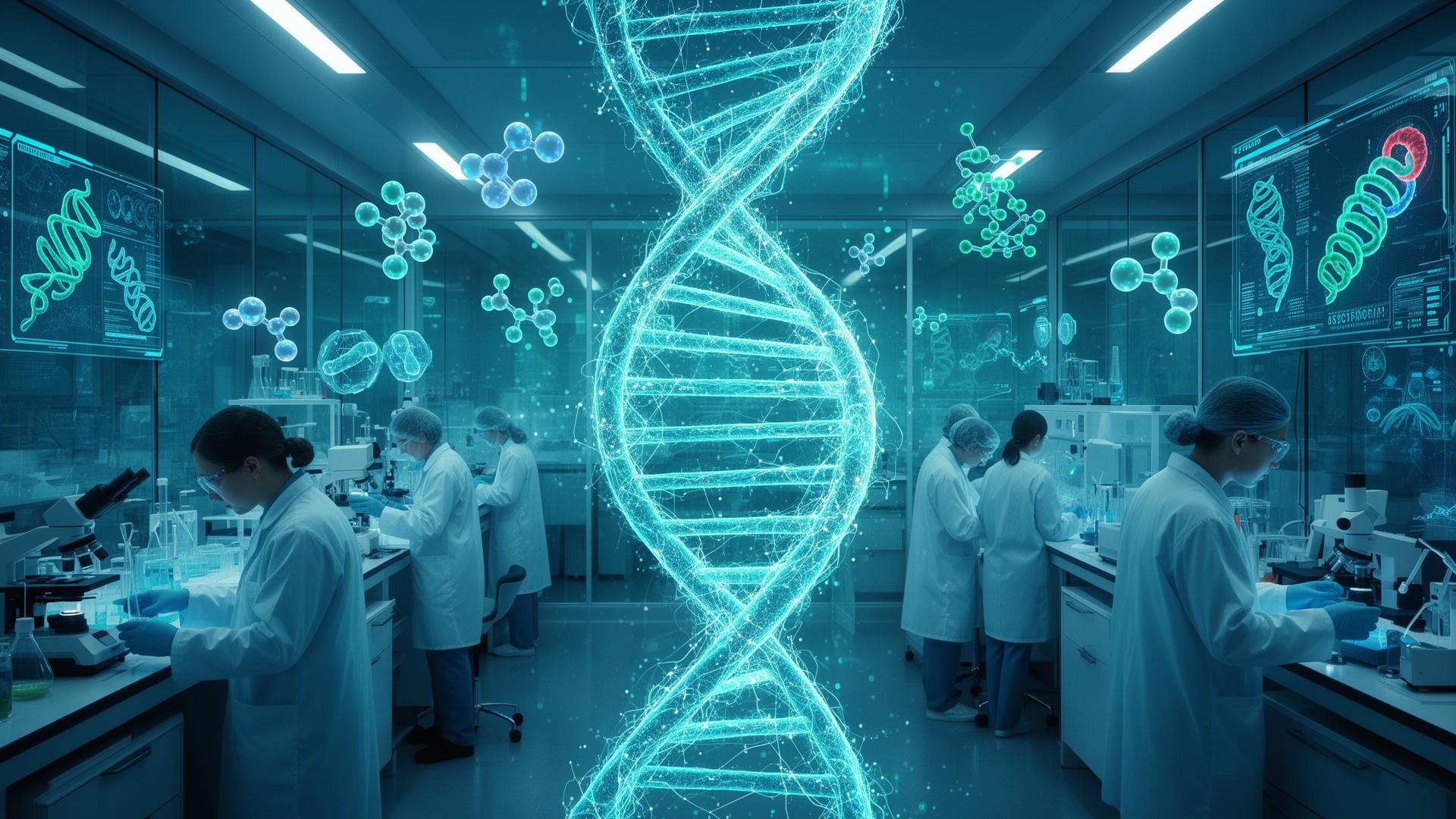
The convergence of Artificial Intelligence and Bioengineering is accelerating biotechnology — and shortening the path to those who need it
In recent years, biotechnology has entered a phase where large-scale biological data, laboratory automation, and Artificial Intelligence (AI) models operate as a single system. This AI + bioengineering convergence is not just an incremental improvement: it is changing how we discover therapeutic targets, design molecules, test hypotheses, and scale new advanced therapy platforms.
In practice, this means faster research, more assertive decisions, reduced costs in critical phases, and most importantly, the possibility of bringing biotechnology benefits to patients faster — with safety, quality, and evidence.
What changed: from "observed" biology to "programmable" biology
Three forces reinforce each other:
1) AI to understand and design biology
Models like protein structure prediction have raised the bar for molecular understanding, helping reduce trial-and-error cycles and accelerate fundamental R&D stages.
2) Bioengineering to transform knowledge into product
Modern editing and biological engineering tools (including advanced gene editing approaches) have expanded our ability to design biological systems with greater precision.
3) Experimental models closer to human
Organoids and other "human-relevant" platforms are gaining scale and quality — and, combined with AI, increase productivity and the ability to read complex biological signals.
Why this matters for Alzheimer's and Parkinson's
Neurodegenerative diseases have a central challenge: they are multifactorial, evolve for years before unequivocal clinical signs, and require therapies that act more intelligently (diagnosis, stratification, intervention, and monitoring).
At the same time, the global burden is growing rapidly:
Dementia (proxy for Alzheimer's)
55 million
139 million by 2050
Parkinson's
8.5 million (2019)
25.2 million by 2050
These numbers make clear an urgency: we need to accelerate innovation without sacrificing rigor — and this is exactly where the AI + bioengineering convergence gains strength.
How AI + Bioengineering convergence can accelerate impact in neurodegeneration
Target and pathway identification
AI helps integrate genomics, proteomics, and clinical data to map targets and biological subtypes with more precision.
Biomarkers and stratification
Improved patient selection and study design, reducing noise and increasing the chance of clinical signal.
New therapeutic modalities
Bioengineering expands the "arsenal" (cell therapies, vesicles/exosomes, protein engineering, and combinatorial approaches), opening paths where traditional therapies fail.
Regenerative medicine: progress is already measurable
Regenerative medicine has gone from a distant promise to a concrete front, with evolving regulatory frameworks and maturing pipelines.
- FDA maintains an official list of approved/licensed cellular and gene products (updated periodically).
- Programs like RMAT (Regenerative Medicine Advanced Therapy) describe criteria and pathways to accelerate development when there is relevant preliminary evidence in serious diseases.
- In Europe, committees like CAT/EMA publish regular reports on ATMPs and regulatory activities.
Mesenchymal cells (MSCs) and exosomes: signs of scientific traction
Even with challenges (standardization, consistency, and endpoints), research volume has grown clearly:
| Type | Metric | Source |
|---|---|---|
| MSC trials | >1,500 registered trials (Dec/2023) | ClinicalTrials.gov |
| MSC historical series | 220 (2012) → 1,073 (2018) → 1,138 (2020) | Industry publications |
| Exosome therapies | >150 clinical trials | ClinicalTrials.gov |
The role of AI: accelerating without oversimplifying
AI is not a "magic shortcut" — but it is already generating real gains throughout the development flow, from discovery to study design. Recent reviews in reference journals describe applications in targets, discovery, preclinical, clinical, and pharmacovigilance.
There are also initial analyses on the performance of AI-supported molecules in clinical pipelines, pointing to the importance of robust metrics and careful evaluation (without hype).
Where Axis Biotec stands
At Axis Biotec, we believe the future of health will be built by organizations capable of uniting:
- infrastructure and manufacturing quality,
- translational science,
- process engineering and traceability,
- and computational intelligence to reduce cycles and increase predictability.
Our focus is transforming innovation into something that makes a real difference: faster for the patient, with governance, safety, and evidence.
Frequently Asked Questions (AEO)
Bibliographic references (with citation links)
- World Health Organization (WHO). Global dementia projections (55M → 139M by 2050).
- World Health Organization (WHO). Parkinson's: global estimates (2019).
- The BMJ (GBD 2021). Parkinson's projections to 2050 (25.2M).
- Jumper et al., Nature (2021). AlphaFold: protein structure prediction.
- AlphaFold Protein Structure Database (EMBL-EBI). Open database with hundreds of millions of predictions.
- Nature Medicine (2024). Review: AI in drug development.
- FDA. RMAT (Regenerative Medicine Advanced Therapy) — criteria and process.
- FDA. Official list of approved/licensed cellular and gene products.
- EMA/CAT. ATMP reports and regulatory activities (e.g., Nov 2024–Jan 2025).
- Reviews on MSC trials and historical evolution of ClinicalTrials.gov registrations.
- Open source review (PMC) on "exosome therapy" trial landscape in ClinicalTrials.gov.
- Nature Medicine (2024). Applications and translation of organoids (clinical vision).
Luís Eduardo da Cruz
CEO, Axis Biotec
Follow Axis Biotec
Connect with us on LinkedIn
Get updates on science, regulation, and innovation in advanced therapies straight from our institutional feed.