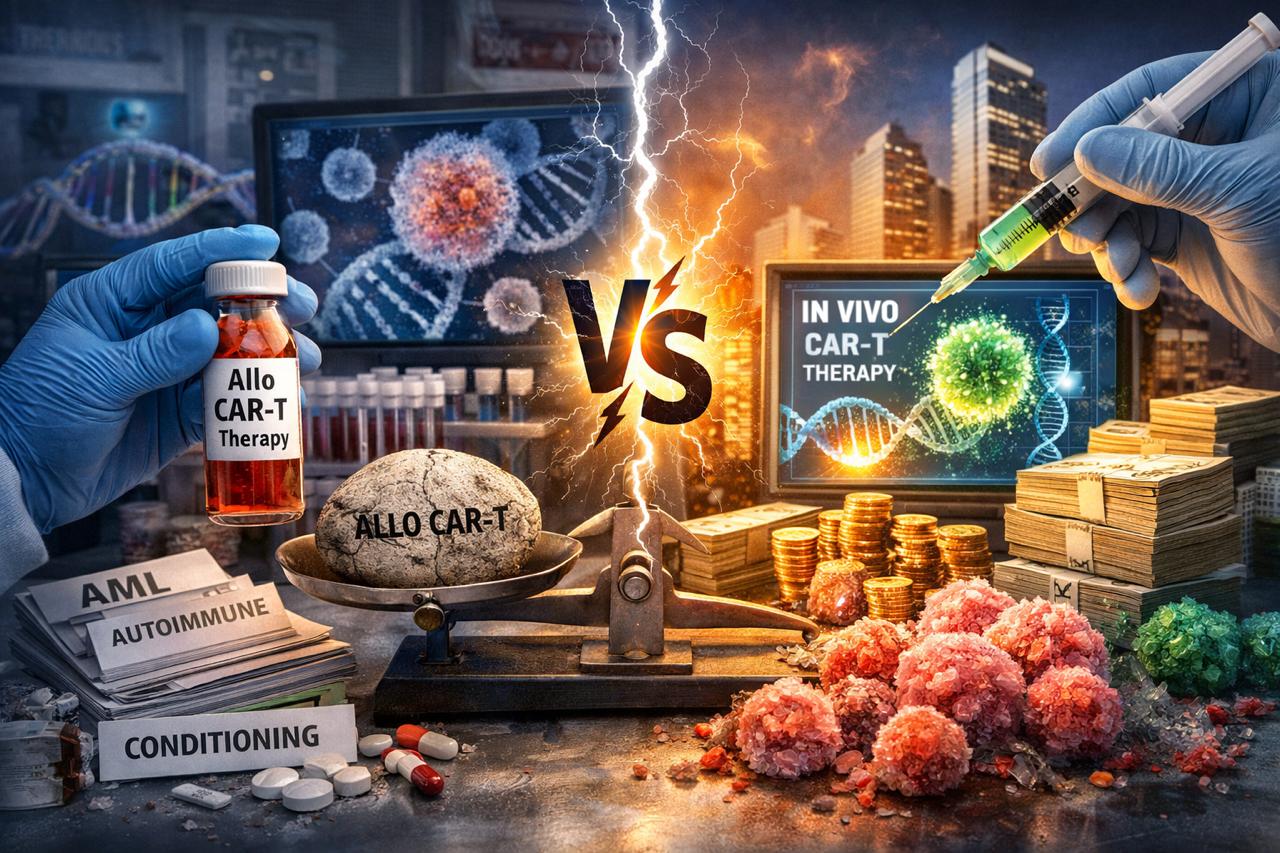
"The only thing that saves us is data" — allogeneic CAR-T biotechs fight for relevance as the industry moves toward in vivo
A highly interesting paper by Darren Incorvaia in Fierce Biotech provides a comprehensive overview of the clash between two approaches competing for the future of cell therapy: allogeneic CAR-T (allo) and in vivo CAR-T. The analysis reveals that allo CAR-T isn't "dead," but faces growing pressure to prove a differentiated advantage — better access, new indications like AML or autoimmune diseases, less conditioning, better persistence — while in vivo CAR-T absorbs attention and billions in investment.
The 2026 clinical data are portrayed as the decisive factor for allo CAR-T's future. And it's precisely in this context that cryologistics infrastructure becomes a strategic differentiator.
Current landscape: allo under pressure, in vivo on the rise
The Fierce Biotech article maps market movements that make the in vivo momentum clear:
There are 7 FDA-approved CAR-T therapies — all autologous. No allogeneic CAR-T has crossed the regulatory finish line, despite over a decade of work.
The core challenge for allo: pharmacokinetics and persistence
The main barrier for allo CAR-T is the rejection of donor cells by the patient's body. As analyst Daina Graybosch (Leerink Partners) explains: "Getting the right exposure remains a massive, challenging barrier. Until you have an allo that gives you excellent, predictable, dose-responsive drug exposure, you haven't solved that fundamental problem."
B2M elimination
Removing beta-2 microglobulin protein to evade recipient T cells — but this triggers alarms in NK cells.
"Don't eat me" signals
Engineering signals like CD47 to deceive NK cells — but NK cells are diverse and don't recognize all decoys.
Partial MHC matching
AvenCell does partial MHC class I knock-out and matches with the patient — covering the entire US population with ~20 unique donors.
Induced stem cells
Fate Therapeutics uses iPSC-derived CAR-T with up to 13 genetic edits, eliminating the need for conditioning.
2026 pivotal data: the decisive year
Three major readouts could define allo CAR-T's future:
| Company | Candidate | Indication | Timeline |
|---|---|---|---|
| Allogene | cema-cel | Lymphoma (post first-line chemo) | Q2 2026 |
| Cellectis | lasme-cel | Acute lymphoblastic leukemia | Q4 2026 |
| Caribou | vispa-cel / CB-011 | Lymphoma / Multiple myeloma | 2026 |
In vivo risks: the other side of the coin
In vivo CAR-T also faces significant challenges, as industry leaders highlight:
- Genomic integration: "hundreds of trillions" of injected DNA fragments could hit oncogenes — tumorigenesis risk.
- Hepatic toxicity with lipid nanoparticles.
- Recent FDA clinical hold on Regenxbio gene therapies after patient developed brain tumor 4 years post-treatment.
- Clinical data still early-stage — phase 1 with few patients.
Where Cryopraxis comes in: infrastructure as a strategic enabler
A company like Cryopraxis — already operating robust cold-chain infrastructure and end-to-end cell handling/manipulation logistics — can be a practical "enabler" for scaling allo CAR-T in Brazil by industrializing the hardest (and most expensive) parts of delivery:
Qualified collection/receiving workflows
Standardized and validated processes for biological material receiving with complete traceability.
Validated cryopreservation
Controlled-rate freezing protocols following international GMP standards.
Ultra-cold storage
Liquid nitrogen tanks with 24/7 monitoring and redundant backup.
Controlled long-distance transport
Cold-chain logistics across the entire national territory with real-time temperature monitoring.
Chain-of-identity / chain-of-custody
Complete traceability from collection to release at treatment centers.
Standardized release processes
Standardized release/dispatch to treatment centers with regulatory documentation.
Economic impact: shared national backbone
By consolidating these capabilities in a shared national backbone (instead of each hospital building from scratch), Cryopraxis can:
| Dimension | Impact |
|---|---|
| Fixed CAPEX | Significant reduction through infrastructure sharing |
| Per-patient logistics cost | Lower cost from temperature excursions, delays, rework, and wastage |
| Turnaround | Reduction of scheduling inefficiencies and lead times |
| Distribution costs | Predictable "lane costs" for therapy distribution |
The result: helping reduce the total cost of treatment and expand access beyond a few major capitals — democratizing CAR-T therapies in Brazil.
Source article
Incorvaia, D. (2026). "'The only thing that saves us is data': Allogeneic CAR-T biotechs fight for relevance as industry moves on." Fierce Biotech, Feb 11, 2026.
Fierce BiotechFrequently Asked Questions (AEO)
References
- Incorvaia, D. (2026). "The only thing that saves us is data": Allogeneic CAR-T biotechs fight for relevance as industry moves on. Fierce Biotech.
- Nature Reviews Drug Discovery (2025). In vivo CAR-T cell therapy — comprehensive review.
- ClinicalTrials.gov — Allogene Phase 2 cema-cel (NCT06500273).
- ClinicalTrials.gov — Caribou Phase 1 CB-011 (NCT05722418).
- FDA. Official list of 7 approved CAR-T therapies (all autologous).
- ACGT Foundation. Approved Cell and Gene Therapies registry.
- Regenxbio — FDA Clinical Hold (Jan 2026) — vector integration and brain tumor.
Luís Eduardo da Cruz
CEO, Axis Biotec
Follow Axis Biotec
Connect with us on LinkedIn
Get updates on science, regulation, and innovation in advanced therapies straight from our institutional feed.